
Computer science empowers scholars with the ability to control and manipulate computers. Every lesson offers scholars the opportunity to explore the digital world, to understand how computers work and why they work the way they do. The aim of the curriculum is to spark a lasting passion in the subject of computer science and provide a platform from which scholars can be and create anything they want in the future. The curriculum ensures all scholars have the skills needed for a successful future using digital media where they can safely find, evaluate, create and communicate information. Computer science augments these skills with problem solving and programming that empowers scholars with the ability and freedom to create anything. The subject promotes problem solving through computational thinking: scholars use abstraction, decomposition, algorithmic thinking and pattern recognition to design creative solutions. Scholars can use the programming skills they learn here as steppingstones to a successful future in the dynamic, growing and exciting world of tech.
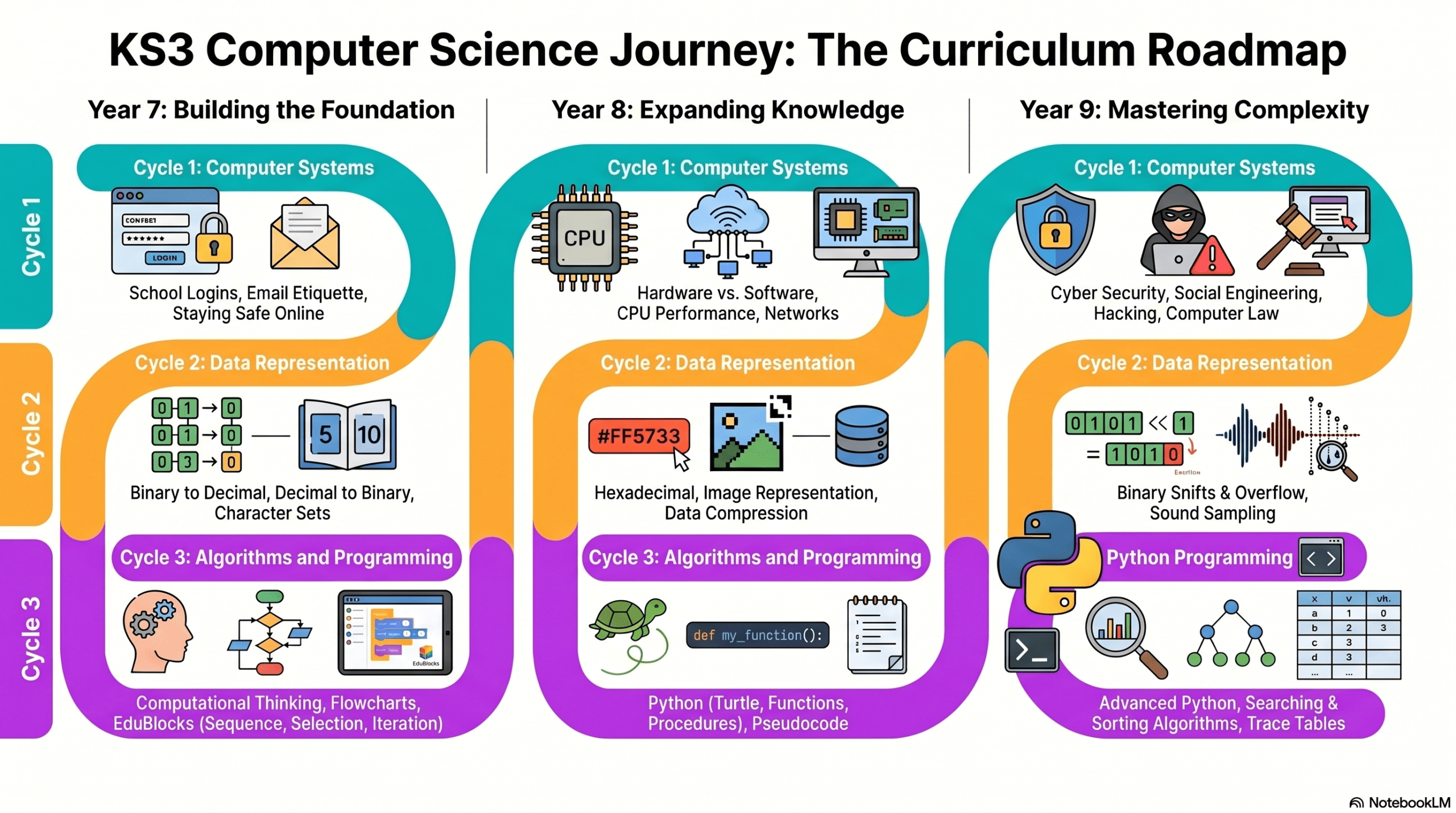
At Key Stage 3, our scholars follow a meticulously sequenced, knowledge-rich spiral curriculum. This design ensures that core concepts in Computer Science, Information Technology, and Digital Literacy are not merely introduced but are revisited and deepened through three distinct cycles each year, building the technical fluency required for transition into KS4.
In Year 7, the focus is on establishing a secure foundation. During Cycle 1, scholars are introduced to the school’s digital infrastructure and essential e-safety protocols, including the management of their digital footprint. We then move into hardware architecture, where they learn to define a computer through the IPOS model and the Von Neumann architecture, specifically the Fetch-Decode-Execute cycle. Cycle 2 shifts to Data Representation, where scholars explore how computers represent text through binary, logic gates (AND, OR, NOT), and character sets like ASCII and Unicode. Cycle 3 introduces computational thinking—focusing on abstraction and decomposition—which is immediately applied through block-based programming in EduBlocks to master basic constructs like sequence, selection, and iteration.
Moving into Year 8, we increase the technical complexity. Cycle 1 deepens their understanding of computer systems by differentiating between General Purpose and Embedded systems and analysing factors that impact CPU performance, such as clock speed, cores, and cache. We also introduce a historical and ethical lens through the study of cryptography and The Bombe. Cycle 2 advances their mathematical competency with binary addition and the introduction of hexadecimal as a more efficient way for humans to represent large binary values. They also investigate image representation and the necessity of lossy versus lossless compression. In Cycle 3, scholars make the critical transition from blocks to text-based Python programming, where they apply the PRIMM (Predict, Run, Investigate, Modify, Make) pedagogical approach to master variables, casting, and complex control structures.
Year 9 serves as the “bridge to mastery.” Cycle 1 focuses on Cyber Security, moving beyond simple safety to analyze social engineering, malware types, and the legal framework of the Computer Misuse Act 1990. Cycle 2 tackles advanced data representation, including binary shifts for arithmetic operations and the digitization of sound through sampling. Finally, Cycle 3 focuses on algorithmic complexity, where scholars learn to compare and execute Linear and Binary searches alongside Bubble, Insertion, and Merge sorts. They utilize trace tables to debug logic errors, ensuring they are prepared for the rigors of the OCR GCSE specification.
To support independent learning and enrichment, all scholars engage with the iDEA award, earning digital badges that recognise their progress in enterprise and employability skills. Retrieval practice is embedded through regular homework assignments, ensuring that key vocabulary and concepts are moved into long-term memory.
Useful Websites:
– iDEA: Develop digital, enterprise, and employability skills for free. iDea Website (https://www.idea.org.uk/)
We encourage you to explore these resources, fostering your child’s curiosity and passion for technology.
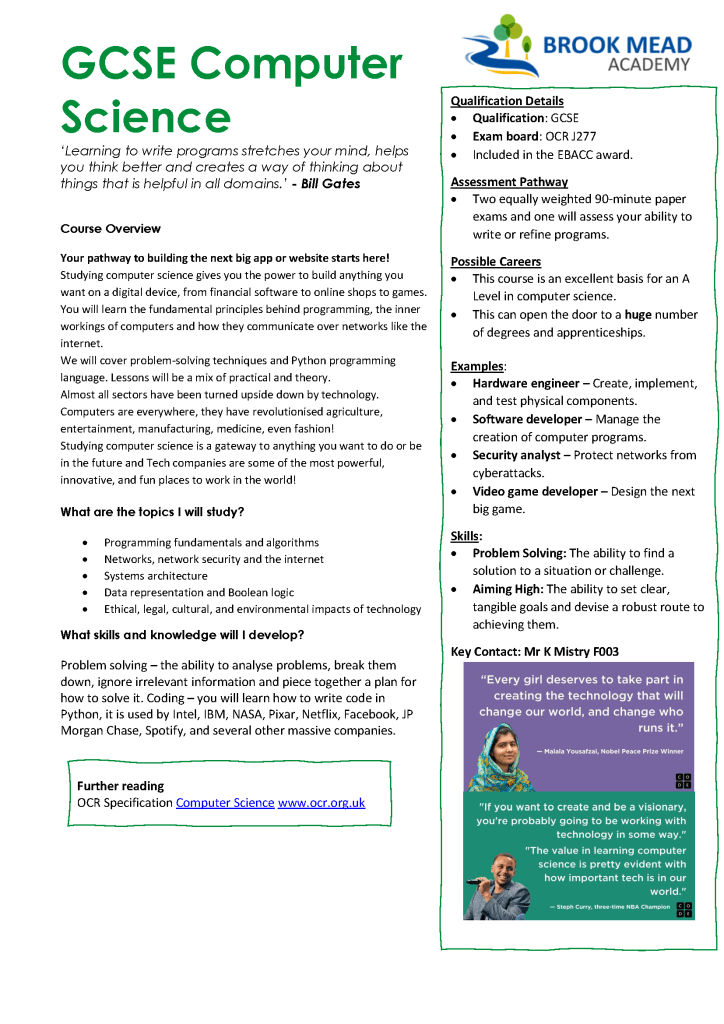
As we embark on Key Stage 4, our scholars will follow the OCR GCSE J277 Computer Science specification. Through an interleaving approach, they will connect various elements of the specification, enhancing their understanding and building a robust knowledge base. The curriculum map/sequence and knowledge organisers guide scholars through the KS4 journey.
To support their progress, scholars will receive essential materials, including CGP Revision Guide, Python Programming Book, Exam Practice Booklet and Smart Revise License. The Smart Revise platform, utilised weekly, aids in revision and knowledge retrieval, requiring an average of 30 minutes per week outside assigned homework.
Regular assessments, both formative and summative, track their progress. The OCR GCSE Computer Science course comprises two 80-mark exams, collectively contributing 50% to the overall GCSE mark.
J277/01 Computer Systems explores Systems Architecture, Memory and Storage, Computer Networks, Security, Systems Software, and the Ethical, Legal, Cultural, and Environmental Impacts of Digital Technology.
J277/02 Computational Thinking, Algorithms, and Programming covers Algorithms, Programming Fundamentals, Producing Robust Programs, Boolean logic, Programming Languages, and Integrated Development Environments.
Our chosen Exam Board is OCR, and the detailed specification can be found GCSE – Computer Science (9-1) – J277 (from 2020) – OCR
National Centre for Computing Education certificate
www.codingclub.co.uk
www.computingacademy.org.uk
www.raspberrypi.org
www.python.org
http://scratch.mit.edu (Massachusetts Institute of Technology)
KS3:
Useful Websites:
– iDEA: Develop digital, enterprise, and employability skills for free. iDea Website(https://www.idea.org.uk/)
– UK Bebras: Enhance computational thinking skills. UK Bebras Website (https://bebras.uk/)
We encourage you to explore these resources, fostering your child’s curiosity and passion for technology.
Microsoft MakeCode for micro:bit (microbit.org)
Teach, learn, and make with the Raspberry Pi Foundation
KS4:
Subject Leader/s
Mr Mistry